

I have seen Amazon from most angles. I consulted on the launch of its consumer electronics store, then served inside as one of its first merchants in the category, spent four years as the national consumer electronics buyer for Sam’s Club competing with Amazon , then built Vigilant Personal Alarms on the Amazon 3P platform into the top personal alarm brand in the United States and sold it to Mace, where I went to work as Executive Vice President. What I found when I got to Mace taught me more about how the platform actually works than anything else in my career.
Mace Security International had been selling on Amazon for a decade by the time I arrived, and by every internal measure the brand was doing ok on Amazon. The listings were established, the reviews had accumulated over the years, the ranking history was real, and the advertising program had been running for years, collecting data. The business was also quietly losing. Not only losing to it’s largest competitor, but to its own unauthorized resellers, who held the buy box on the brand’s own products and collected on demand that Mace had spent ten years and a considerable amount of money creating. We removed them, took control of the buy box, and then did the work that control made possible: rebuilding the listings to our own marketing and brand standards, with current creative, correct specifications, and the positioning the company had actually developed. In the first six months of executing the strategy I want to describe here, the business grew 140%.
One problem for a couple of companies I have in my sights right now is their lack of control of Amazon, and what it is doing to their brand perception on the world’s largest billboard. Even if your core business isn’t Amazon centric, you have to own the skies of Amazon in your category and for your brand so that someone else isn’t defining you without your participation. Your brand on Amazon represents you, good or bad, even if it’s not you that is controlling it. And controlling your brand on Amazon is yours for the asking, if you know what you are doing.
The Mace product did not change during those first six months. What changed was who controlled the ground, who controlled the skies and what we were able to build once we held both. The rapid acceleration we experienced was from the brand alignment, which I have since memoralized into a structure, repeated it with other companies, and the model now creates predictable scale that Amazon insiders have called a “best in class framework.”
Two problems, and the second one is worse
The revenue leak is the obvious cost, and it is the one that shows up if anyone goes looking. Every dollar spent driving traffic to your own product detail page, every impression won defending your own branded search, every customer persuaded to choose your brand over a competitor’s, all of it converts for whoever holds the buy box at the moment of purchase. If that is not you, then you are financing demand generation on behalf of someone else, continuously and at scale, without any line item that reveals it. Advertising into a compromised buy box is a subsidy to your resellers.
Publicly held companies or companies with or seeking outside investors should be obsessed with capturing top line revenue and owning bottom line margin with as few hands in the cookie jar as possible. Both of those metrics are visible to the street and to investors, and ignoring those because you’re concentrating elsewhere makes no sense, for any company. - Dave Happe, Retail Reasoning
What allows sales and margin bleed to persist is that the reports look fine. Sales exist, return on ad spend is calculable, campaigns are running and can be optimized. None of the standard reporting contains a field for who is actually capturing the revenue those campaigns produce, so the problem stays invisible from the dashboard even as it compounds. Your team might not even understand the metrics.
The second problem is less visible still, and over a long enough period it does more damage. When resellers create listings for your products, and they do, routinely, they are the ones writing your brand’s story on the largest product research platform in American retail. Those listings rarely carry the current creative. The specifications are often incomplete or simply wrong. The imagery is whatever was available or was available before you upgraded it. The positioning that your marketing organization spent years and real money developing does not appear at all, because the person who built the page had no reason to include it. The content in almost every case where you don’t control it is not consistent with your own content, or your own brand standards. From an intellectual property standpoint, you need to own the ground and the skies on Amazon and control how your brand is presented. Consumers, and even corporate buyers, use Amazon as one stop if not their primary stop when researching your brand. They need to see exactly what you want them to see.
The incentives explain everything here. A reseller who acquired a pallet of your product is optimizing to move that pallet and exit, full stop. Meanwhile, your owned brand is optimizing for the customer who buys again in three years and tells someone else in the meantime. Those two objectives produce entirely different pages, and only one of them is what the customer sees. What Mace had lost, alongside the margin, was authorship of its own brand: dozens of pages representing the company to the market, none of them written by anyone with a stake in what the company became.
Sidebar: It’s worth pointing out today that Mace was acquired by Westinghouse, and a whole different team of executives, directors, and creatives are in charge of that business, which has benefited today from that change of control.
The correction, for both problems, is usually less dramatic than executives expect. Most unauthorized sellers value their Amazon selling account considerably more than they value any single line of unauthorized distribution, and when a brand asserts its channel policy clearly, the majority of the problem tends to resolve without much resistance. It is worth being precise about what is happening in that moment. Who is authorized to sell your product is a decision the brand makes upstream, in its own distribution agreements, and the marketplace sits downstream of that decision. Executives brace for a legal war and usually find a paperwork exercise. Amazon seldom intercedes, but has specific tools available that benefit brand holders in maintaining channel integrity, because that ultimately benefits Amazon consumers. You just have to know which buttons to press, and when.
That step is necessary but it is not the win. Clearing the ground only creates the conditions to build on it, and the building is where the return actually comes from. What produced the result at Mace was not the removal itself. It was everything we were finally able to execute afterward, on pages we controlled, in a voice that was ours. Clearing the ground and owning the skies is step one before we implement what I have coined as the Four Pillars. I actually was able to present the Four Pillar strategy to Amazon insiders, and that’s where the “best in class” comment came from. It’s a framework that I have been refining since 2016, and now can tell you that it is replicable in almost any consumer or consumable category.
The Four Pillars
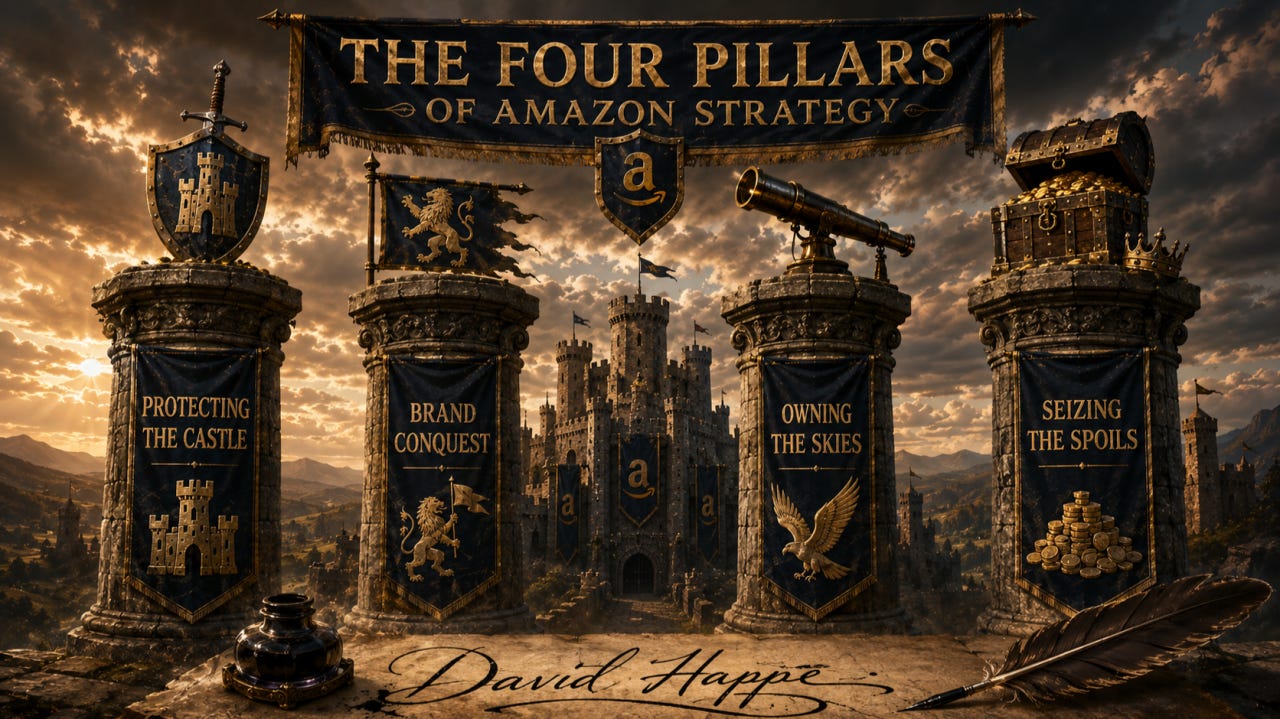
Once a brand controls its own position on the marketplace, the buy box and the pages both, there is an actual strategy to run. Not a collection of campaigns to optimize, but a system with a sequence and an internal logic. I developed this framework across every business I have operated on Amazon, first as an insurgent brand taking share and later as an incumbent defending it, and it has held up in both directions.
There are four battlefields.
Protecting the Castle. Every brand has a digital castle on Amazon: its branded search results, its product detail pages, its category position, and the demand it has already earned. The first responsibility of any Amazon strategy is to hold it. When a customer searches for your brand by name, they have already made the hardest decision a marketer can ask anyone to make, which is choosing you. If a competitor appears alongside your product in that moment, they are inside your walls, spending pennies to intercept a customer you spent years and a great deal of money creating.
The strategic question: are we protecting the customers who are already looking for us? Do you own your own brand space on Amazon?
Brand Conquest. Defense alone is a slow death. Every competitor in your category has built the same asset you have, and that asset is reachable. Brand Conquest reframes the growth question entirely. Rather than asking how to get more people to buy your product, which requires manufacturing demand at considerable expense, it asks whose customers you can win. Demand that already exists is meaningfully cheaper to redirect than demand that has to be created from nothing, and most brands never pursue it systematically.
The strategic question: whose customers can we take?
Owning the Skies. The first two pillars fight at ground level. The third operates above it, in the deliberate construction of category-wide presence until the brand becomes difficult to ignore. Not every impression is meant to convert. The objective is mental availability, which is to say being the brand that surfaces when the customer eventually decides. This matters more now than it did five years ago because of where the category conversation has moved. Amazon accounts for more than 79% of all US retail media digital advertising spending.[1] The conversation is not happening elsewhere and spilling onto the platform. It is happening there. Here I am not talking about people searching for you. I am talking about people investigating the category, and finding you as the most viable answer.
The strategic question: when customers think about this category, how often do they see us?
Seizing the Spoils. The first three pillars create conditions. The fourth collects. Amazon is unusual among advertising environments because customers arrive with intent already substantially formed, and what remains is the decision itself, which gets made on the page. This is where authorship of the listing stops being an administrative matter and becomes the whole game, because the page is the last thing standing between intent and revenue. Advertising brings the customer to the door. The offer closes the sale. Here is where I want to maximize top line sales and bottom line margin. I own the skies and the ground.
The strategic question: having earned the customer’s attention, are we giving them a reason to choose us?
What I have laid out here is the architecture. The operating detail behind it is a different document: the sequence the pillars run in and why the order is not negotiable, the thresholds that tell you a brand is ready to move from one to the next, the diagnostic that determines which pillar is actually broken when performance stalls, and the execution standards that separate a pillar being present from a pillar being effective. That took two decades to develop, and it does not belong in a LinkedIn post.
Defend, conquer, dominate, convert
The four pillars are not parallel, and the order is the whole point. You cannot defend ground you do not hold, you cannot conquer from an unstable base, you cannot own the airspace above contested territory, and you certainly cannot convert traffic you have paid to send somewhere else.
The most common failure I encounter is not a bad Amazon strategy at all. It is three good pillars running on compromised ground, a brand executing conquest, category presence and conversion optimization at real and sustained expense while the first pillar is quietly broken underneath all of it. The spending works exactly as designed. It simply works for somebody else.
The framework applies in both directions, which is worth saying plainly. A brand whose Amazon business is underperforming almost always has a first-pillar problem it has never diagnosed, because nobody looked. A brand whose Amazon business is performing well almost always has substantial upside in the second and third pillars that it has never pursued systematically, because nobody framed the category as territory that could be taken. Poor businesses become good ones and good businesses become great ones, but both begin at the same gate. You don’t get here by just throwing some advertising money at some key words.
“If you know the enemy and know yourself, you need not fear the result of a hundred battles” - Sun Tzu, The Art of War
Why this reaches well past Amazon
Amazon accounts for roughly 40% of all US e-commerce sales,[2] and its share of US marketplace e-commerce runs above 60%.[3] Those figures alone would justify executive attention, but the strategic case is larger than the revenue, and it is the part I find most consistently underweighted in the boardroom.
Amazon has become the public record of your brand. It is where your reviews live, where your ratings are visible, where your pricing is posted, and where anyone, including the people deciding whether to carry you, can determine in about thirty seconds how the market actually receives your product. Which is precisely why the question of who writes those pages is not a merchandising detail.
I sit across from big box and regional buyers on a regular basis, and they pull up Amazon during the meeting. Not afterward as part of some later due diligence process, but while I am presenting, on their own screen, checking what the market says about the line I am there to sell them. Recently I watched a buyer at a national retailer research a product line on Amazon in real time while we were discussing it, which is not an unusual occurrence so much as a routine one.
I spent a dozen years as a national buyer myself, so I know exactly what that buyer is doing. They are not looking for your sell sheet, which you wrote and which tells them what you want them to believe. They are looking for evidence: reviews, ratings, rank, and whether the brand reads as winning or drifting. If what they find was assembled by someone who bought a pallet and wanted to move it, that is the brand they are evaluating, regardless of what is in your presentation.
Your Amazon presence, in other words, is no longer merely a revenue line. It is a credential you present to every other retailer whether you intend to or not. When it is wrong, it argues against you in rooms you will never sit in. When it is right, it opens doors that have nothing to do with Amazon at all.
Protecting the Castle. Protect what you already own.
Brand Conquest. Take what your competitors own.
Owning the Skies. Become impossible to ignore.
Seizing the Spoils. Win the customer when it matters most.
That is the Amazon battlefield. But before any of it, there is a simpler question, and most executives cannot answer it. Who holds your buy box right now, and who wrote the page it sits on?
It takes about ninety seconds to find out. You can email me after you read this article at happe1@pm.me, but spend 90 seconds on Amazon first searching for your own brand name.
This is the top-level architecture of a proprietary framework I developed across two decades of operating on and inside Amazon. For additional information or to schedule a low cost flat rate audit, visit www.3PXRay.com
David Happe helped launch Amazon’s consumer electronics store and was one of its first merchants in the category. He grew up at Best Buy corporate, spent four years as the national consumer electronics buyer for Walmart Sam’s Club and later founded Vigilant Personal Alarms and built it to category leadership before selling it to Mace, where he subsequently served as Executive Vice President. He writes The Retail Brief and owns Retail Reasoning, a retail analytics platform launching in late August 2026.
Sources
[1] EMARKETER, “FAQ on ecommerce marketplaces: The shift from Amazon-only to multi-marketplace,” July 2026. Amazon accounts for more than 79.0% of all US retail media digital ad spending in 2026. https://www.emarketer.com/content/faq-on-ecommerce-marketplaces--shift-amazon-only-multi-marketplace
[2] EMARKETER, July 2026. Amazon holds 39.7% of all US ecommerce sales in 2026. https://www.emarketer.com/content/faq-on-ecommerce-marketplaces--shift-amazon-only-multi-marketplace
[3] EMARKETER, “Amazon’s Share of US Marketplace Ecommerce Peaked in 2022 and Will Slip to 63.3% in 2026,” October 2025. https://www.emarketer.com/chart/273567/amazons-share-of-us-marketplace-ecommerce-peaked-2022-will-slip-633-2026-billions-us-amazon-marketplace-sales-change-of-total-retail-marketplace-ecommerce-sales-2020-2027