

Retail Reasoning | September 14, 2026
The Antitrust Division spent the spring taking apart the meatpackers and spent July writing to grocers. The letters it sent are the most interesting document produced in American retail this year, and that has less to do with who received them than with what they ask for. Eight companies got one: Kroger, Publix, Walmart, Albertsons, Aldi, Ahold Delhaize USA, Costco and Amazon. Associate Attorney General Stanley E. Woodward Jr. signed identical letters dated July 14, addressed separately to each, concerning what the department called recent increases in the retail price for beef.1 The division made the expansion public in a post on its X account at the start of September, framing beef prices as a critical concern to Americans and a priority for the department.2
Before going any further, the caveat that most of the coverage has skipped. None of the eight has been charged with anything, and none has been found to have violated an antitrust law. A demand for records is a question, not a finding, and the distinction is going to get lost in a hurry over the next few months.
What the department actually asked for
Read the request list and you stop thinking about beef. The letters seek records on retail beef sales and prices, wholesale purchases, costs and margins, pricing and purchasing strategies, and each company’s own internal analyses of wholesale and retail beef price trends, all of it covering 2020 through 2026. Investigators also asked that company personnel brief them on four areas, including how beef pricing strategies and margins changed over those six years, how costs moved across the same period, and how each retailer structures its wholesale arrangements for buying beef from the packers.3 Strip away the subject matter and what has been requested is a category P&L, six years deep, from eight companies, delivered in comparable form to the same set of lawyers.
I have sat in the meetings where documents like that get produced, and the thing worth understanding is that none of them were written for this audience. The pricing strategy deck, the margin bridge, the competitive shop file, the vendor funding schedule, the one-line note explaining why a cost increase went through at a hundred and ten percent instead of a hundred, all of it was written by a merchant for another merchant in merchant shorthand, on the reasonable assumption that everybody reading it would understand the trade. Somebody else is reading it now, and that somebody is reading for intent. Sarbanes Oxley laws mean that all of these retailers have a perfectly preserved record of all correspondence covering this time period, and now all of it will be in the hands of regulators.
How this started, and why it did not stop at the plant
The chain of events is short and entirely public. In November 2025, President Trump accused meatpacking companies of driving up beef prices through collusion, price fixing and price manipulation, and asked the Justice Department to investigate. On December 6 he signed Executive Order 14364, which stood up Food Supply Chain Security Task Forces inside both DOJ and the FTC and aimed them at anticompetitive behavior across the food supply chain, naming meat processing alongside seed, fertilizer and equipment as sectors with similar vulnerabilities.4
In May the Antitrust Division opened a criminal investigation into the Big Four packers, JBS, Cargill, Tyson Foods and National Beef, which the department says control more than 85 percent of U.S. beef processing. By late summer it had reviewed more than three million documents and was interviewing industry participants, and Attorney General Todd Blanche had publicly pointed whistleblowers toward the reward program, offering 15 to 30 percent of any criminal penalty above a million dollars.5
So the department worked the concentrated middle of the chain for a full quarter, with subpoena power and three million documents in hand, and then moved downstream. There are two ways to read that sequence. Either the packing case is strong and retail is being pulled in to complete the picture, or the packing case did not find what it expected and the money had to be somewhere else. I lean toward the second reading, and the public data is the reason why.
The number that sent them to the shelf
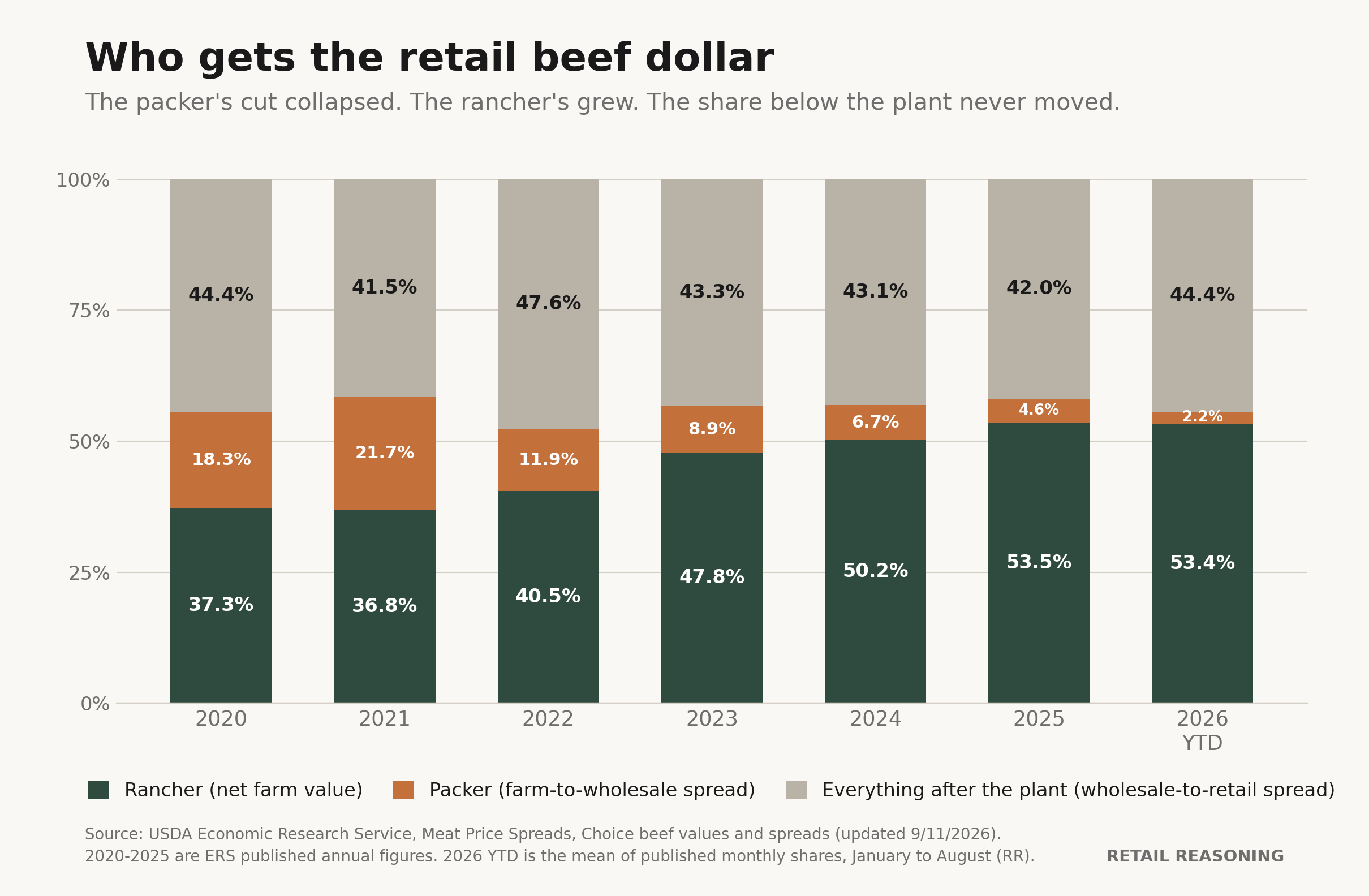
USDA’s Economic Research Service publishes meat price spreads every month, splitting the retail beef dollar into three pieces: what the rancher gets, what the packer captures between the farm gate and the wholesale carcass, and what accrues between the wholesale carcass and the meat case. For August 2026, Choice beef carried a retail value of $10.23 a pound, the farm-to-wholesale spread was 39 cents, and the wholesale-to-retail spread was $4.61.6
Those proportions have held all year. The packer piece has run between six and fifty-five cents a pound every month since February, while the downstream piece has not dropped below $4.18 across the same stretch.6 Roughly ninety-two percent of the total spread between the ranch and the register now sits below the plant. For an antitrust lawyer trying to work out where the consumer’s dollar went, that is not a subtle signal, and it is the most plausible explanation for why eight grocers got mail in July.
The case for the defense, and it is a real one
Here is where honest analysis has to part company with the press release, because that $4.61 is not retailer profit. It covers the entire cost of everything that happens to a carcass after the packer sells it: fabrication into subprimals and case-ready cuts, cold chain freight, grinding, tray packing, film and labels, store labor at the meat counter, shrink on a product with a five-day shelf life, and markdown on whatever does not move by day five. Beef is the most labor-intensive and most perishable department in the building, and it has always carried the widest spread in the store.
The rancher’s share of that dollar has also gone up rather than down, which is awkward for the theory. ERS puts the farmer’s share of the retail beef dollar at 51.1 percent in August, and it ran as high as 55.6 percent in May.6 The comparable figure in May 2022 was 41 percent.7 Producers are capturing ten points more of the consumer dollar than they were four years ago, and that is not the pattern anybody would expect if retail buyer power were squeezing the chain.
The packers, meanwhile, are bleeding. On September 3 Tyson Foods cut its fiscal 2026 outlook for the second time in a month and guided its beef segment to an adjusted operating loss of $625 million to $775 million, citing margin compression amid volatile cattle prices and one of the most severe cattle shortages in U.S. history.8 The company is closing its Joslin, Illinois plant and its Eagle Mountain, Utah case-ready facility and shopping the Pasco, Washington plant. Cartels do not generally restructure around three facilities and book three quarters of a billion dollars in segment losses.
Retail gross margins are moving the wrong way for the prosecution as well. Kroger reported second quarter gross margin of 22.4 percent of sales on September 11 against 22.5 percent a year earlier, lowered its identical sales guidance for the year, and told analysts it will resist supplier price increases that are not justified by costs.9 A consolidated margin can certainly conceal a category margin, and finding that out is exactly what the letters are for, but the number that is currently public is falling rather than rising.
Most of the price story is explained by supply without anybody breaking a law. The January 1 cattle inventory came in at 86.2 million head, the smallest herd since 1951, with beef cows at 27.6 million, the lowest since 1961.10 Ground beef averaged $6.92 a pound in August, a record.11 Beef and veal CPI is already decelerating hard, running from 16.4 percent year over year last December to 9.4 percent in July and 5.9 percent in August.6 That is the cattle cycle doing what the cattle cycle does, and cattle producers still want the retail books opened anyway. R-CALF USA, which called for precisely this back in May, said it was encouraged by the expansion and urged enforcement wherever anticompetitive conduct is found, pointing to the widening gap between cattle prices and beef prices.12
Publix is the one I would watch
Seven of the eight are national operators and one is not, which is what makes Publix the most interesting name on the list. Antitrust in grocery gets measured locally, because nobody shops nationally and the relevant market for a pound of ground chuck is the set of stores a household can reasonably drive to. On that measure Publix carries a concentration in its home markets that none of the other seven approach in theirs. Chain Store Guide put its share of the Miami metro at roughly 47 percent in 2023, against 15 percent for Walmart and 8 percent for Costco.13 That data is a few years old and grocery share numbers are never clean, but the shape of it is right, and shape is the first thing an investigator looks at.
There is a second reason to watch Publix, which is that the company already publishes a version of what the department just asked eight retailers to produce. The stock does not trade and the business is employee-owned, but Publix is an SEC registrant and files a 10-K like everybody else. Almost nobody in retail bothers to read it, and what is in it cuts against the theory. Gross profit as a percentage of sales was 25.4 percent in 2025, 25.6 percent in 2024 and 26.3 percent in 2023.14 Walk the filings back and the same line reads 26.8 percent in 2022, 27.4 percent in 2021 and 27.9 percent in 2020.15 That is 250 basis points of gross margin surrendered across almost exactly the window the Antitrust Division defined in its letters.
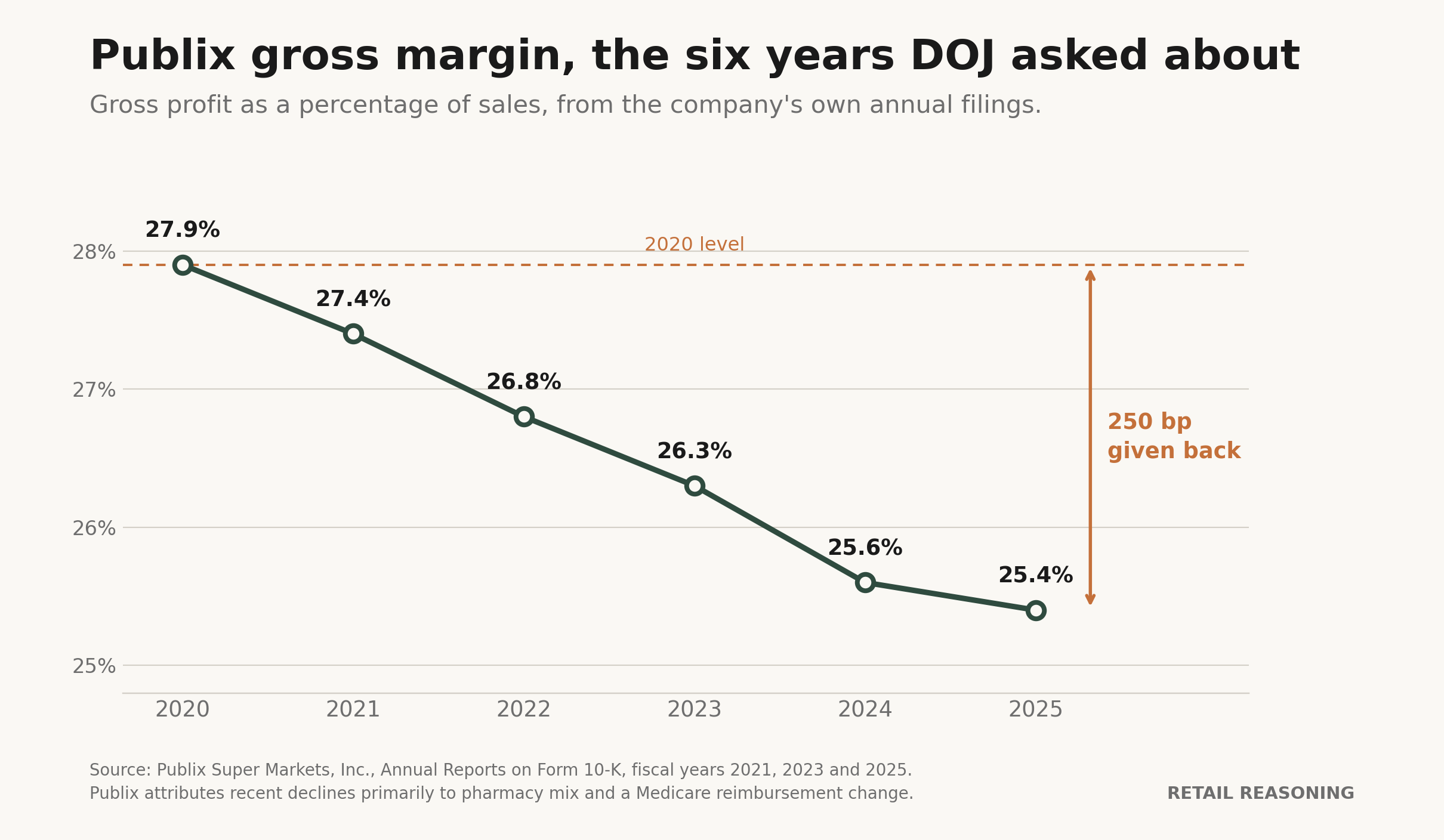
Publix attributes the recent decline to pharmacy mix and a Medicare reimbursement change rather than anything happening at the meat counter, and its 2023 filing attributed part of that year’s compression to product cost inflation the company chose not to pass on to customers.15 Setting the figure alongside Kroger’s 22.4 percent takes some care, since Kroger sells fuel and Publix does not, and fuel drags a consolidated gross margin down by several points. The two numbers are not the same measurement. What is comparable between them is direction, and both are heading the same way.
The harder look will come below the gross line. Publix net earnings landed at 7.5 percent of sales in 2025, or 6.7 percent once unrealized gains on the company’s equity portfolio come out.14 For a supermarket operator that is an unusually profitable business and has been for decades, and it is a business with no outside shareholders and no quarterly earnings call where an analyst gets to ask about the meat department. An investigator reading those facts sees a regionally dominant grocer with peer-leading profitability and no external pressure on its pricing. A merchant reading the same facts sees a company running excellent stores in a state with punishing real estate and labor costs, handing margin back five years running. Both readings fit the public record, and only the documents settle it.
Why this reaches past the meat case
If you run a category that has nothing to do with protein, the reason to pay attention is the method rather than the subject. Executive Order 14364 did not create a beef task force. It created a food supply chain task force at two agencies, with seed, fertilizer and equipment written into the text alongside meat processing.4 The department has now demonstrated the full play: open at the concentrated manufacturing tier, run it criminally, then send civil information demands to the retailers who touch the consumer and ask them to explain six years of category margin against six years of category cost. That template travels to eggs, dairy, baby formula, pet food and anything else with a concentrated manufacturing base and a shelf price that made the news.
It also collides with how modern retail actually earns its money. A grocery category P&L in 2026 is not cost plus markup. It is cost, less vendor funding, less scan-down allowances, less slotting, plus retail media attributable to the category, plus private label mix, net of loyalty-funded price investment. Kroger has just told the street it is funding shelf price reductions nearly one for one out of sourcing savings.9 Explaining a structure like that to somebody whose mental model is cost plus margin is genuinely hard work, and for these eight companies it is going to get done under subpoena rather than in a conference room.
The decision window
Preservation obligations attached the day the letters arrived, and the letters instructed the companies to preserve relevant documents, so that door has already closed for the eight. For everybody else it is open now and stays open until a letter lands on your own mat.
If you buy a concentrated category, pull your cost-to-shelf bridge for 2020 through 2026 this quarter and make sure somebody who is not a merchant can follow it end to end. If you cannot explain a pass-through decision from the documents alone, fix the documentation before a stranger reads it cold. If you sell into one of these retailers, your wholesale arrangements are now discoverable at eight of your largest customers, and category management agreements, promotional funding terms and exclusivity language will all get read in that light. And if you make the product, look hard at what happened to Tyson, which is carrying the criminal exposure and the losses at the same time. Concentration is a liability on both sides of the ledger in this cycle.
My read is that the retail piece of this ends in a report and a set of recommendations rather than a criminal case, and I would put that at better than two to one. The spread data says the money is downstream, but it does not say the money is illegal, and a farm share that has climbed ten points in four years is going to be hard for the department to argue around. The precedent set by the request survives the outcome either way, and that is the part worth planning for.
The investigation will run for years, but the document production will not. The companies that come out of this well are going to be the ones whose category economics were already written down in language an outsider could follow.
Keep thinking a few moves ahead.
Sources
Michael Sinkewicz, “DOJ expands beef price investigation to Walmart, Costco, Amazon and other major retailers,” Fox Business, September 2, 2026. Letters obtained by the outlet and quoted directly. ↩
Reuters, “US Justice Department expands beef price probe to eight retailers,” September 2, 2026, reporting the Antitrust Division’s post on X naming all eight companies. ↩
Fox Business, September 2, 2026, itemizing the four briefing areas and the 2020 through 2026 records request. Corroborated by Pam Danziger, “DOJ Widens Meat-Pricing Probe To Walmart, Kroger, Costco And Other Major Retailers,” Forbes, September 3, 2026. ↩
Executive Order 14364, “Addressing Security Risks From Price Fixing and Anti-Competitive Behavior in the Food Supply Chain,” signed December 6, 2025, published at 90 Fed. Reg. 57349 (December 10, 2025). The order establishes Food Supply Chain Security Task Forces at DOJ and the FTC and names meat processing, seed, fertilizer and equipment. ↩ ↩2
Fox Business, September 2, 2026, reporting the May opening of the Big Four investigation, the three million document review, Attorney General Todd Blanche’s whistleblower remarks, and Agriculture Secretary Brooke Rollins on herd size. ↩
U.S. Department of Agriculture, Economic Research Service, Meat Price Spreads, “Summary of retail prices and price spreads,” monthly series through August 2026. Choice beef retail value, beef farm-to-wholesale spread, beef wholesale-to-retail spread, farmers’ share of the retail beef dollar, and the CPI beef and veal 12-month percent change series are all drawn from this file. ↩ ↩2 ↩3 ↩4
U.S. Department of Agriculture, Economic Research Service, “Data Training Webinar: Price Spreads from Farm to Consumer & Meat Price Spreads,” citing a 41 percent farm share of the retail beef price in May 2022. ↩
Tyson Foods, Inc., “Tyson Foods Updates Fiscal 2026 Outlook,” press release, September 3, 2026. Beef segment adjusted operating loss guidance of $(775) million to $(625) million. ↩
The Kroger Co., “Kroger Reports Second Quarter 2026 Results and Updates Guidance for 2026,” September 11, 2026, and the accompanying earnings call transcript. Gross margin of 22.4 percent of sales versus 22.5 percent in the prior-year quarter. ↩ ↩2
U.S. Department of Agriculture, National Agricultural Statistics Service, Cattle, released January 30, 2026. All cattle and calves at 86.2 million head as of January 1, 2026, and beef cows at 27.6 million head, down 1 percent year over year and the lowest since 1961 per University of Kentucky Agricultural Economics analysis of the same release. ↩
U.S. Bureau of Labor Statistics, Average Price Data, series APU0000703112, ground beef 100% beef, U.S. city average. August 2026 value of $6.923 per pound, retrieved via FRED, Federal Reserve Bank of St. Louis. ↩
R-CALF USA, “R-CALF USA Statement on DOJ Expansion of Beef Price Investigation,” September 2, 2026. CEO Bill Bullard quoted urging investigation of both the meatpacking and retail sectors. ↩
Chain Store Guide data reported in “Publix still dominates grocery in Miami,” Supermarket News, May 7, 2024, covering 2023 metro-level share. Figures are as of 2023 and have not been updated since. ↩
Publix Super Markets, Inc., Annual Report on Form 10-K for the fiscal year ended December 27, 2025, filed March 2, 2026. Gross profit as a percentage of sales of 25.4 percent, 25.6 percent and 26.3 percent in 2025, 2024 and 2023, and net earnings of 7.5 percent of sales in 2025, or 6.7 percent excluding net unrealized gains on equity securities. Second quarter 2026 results from the company’s Form 8-K exhibit dated August 3, 2026. ↩ ↩2
Publix Super Markets, Inc., Annual Reports on Form 10-K for fiscal years 2023 and 2021, reporting gross profit as a percentage of sales of 26.8 percent in 2022, 27.4 percent in 2021 and 27.9 percent in 2020, and attributing part of the 2023 decline to product cost inflation not passed on to customers. ↩ ↩2