

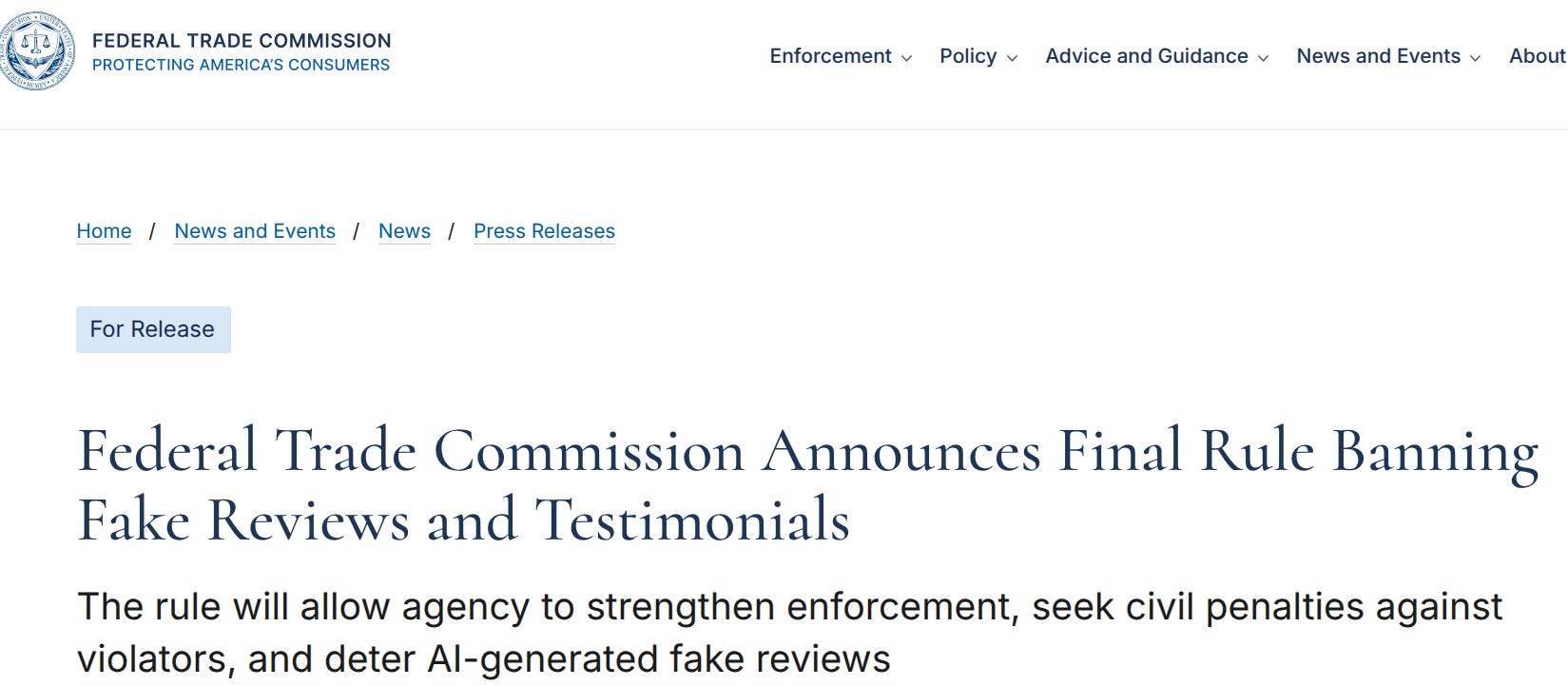
When the FTC announced its final Rule on the Use of Consumer Reviews and Testimonials in August 2024, the press release led with AI-generated fake reviews and bought five-star ratings. Every e-commerce operator I know read it the same way. Amazon sellers were about to get hunted. The broker networks were about to get shut down.
The rule took full effect October 21, 2024.
Here is who the FTC has actually gone after.
In December 2025 it sent warning letters to ten companies. First public enforcement step under the rule, and the agency would not say who got them. A FOIA request pried the letters loose and the FTC posted them in April.
Six property management companies. Three personal injury law firms. One accounting firm.
Not a marketplace seller on the list. Not a consumer brand. Not a single ASIN.
The conduct was nearly the same in all ten. Lease discounts, gift cards, and other incentives handed to tenants, customers, and employees in exchange for a positive review, or for pushing friends and family to post one.
So the rule everybody read as an Amazon rule got used on landlords.
Before you file that under good news, read the rest. The way this rule is being used is worse for you than a marketplace sweep would have been.
What the rule bans
Six things, codified at 16 CFR Part 465.
Fake or false reviews. People who do not exist, including AI-generated ones, or people who never touched the product. Creating them, selling them, buying them, or publishing them when you knew or should have known.
Incentives tied to sentiment. Paying or rewarding anyone for a review expressing a particular opinion, good or bad. The condition can be implied. It does not have to be in writing.
Insider reviews without disclosure. Officers, managers, employees, agents. Also what happens when a manager asks their own relatives, or tells employees to go ask theirs.
Company-controlled review sites. Running an “independent” comparison site that somehow ranks your own products well.
Suppression. Groundless legal threats or intimidation to kill a bad review. Also claiming your displayed reviews represent all or most of what came in, after you have filtered by rating.
Fake social indicators. Bought followers and views for commercial purposes.
Maximum civil penalty is $53,088 per violation as of 2026. No inflation adjustment applied this year, so that figure holds.
Per violation. Not per campaign. Sit with that number for a second, because it is the whole game.
The two cases
TruHeight, April 2026. A supplement company selling vitamins it claimed were clinically proven to make children grow taller. The case was about unsubstantiated health claims. Down in the complaint were the review counts: employees posing as real customers on the company’s own site, and buyers handed free product or a discount for five stars. Final order came July 15, 2026. Injunction, plus a $4 million judgment cut to $750,000 on inability to pay.
Premium Home Service, May 2026. The FTC and the Illinois Attorney General sued PHS and its owner for building thousands of fake local business listings so people thought they were hiring a neighborhood repair outfit. The complaint says PHS directed employees, relatives, and SEO vendors to post fake five-star reviews for the specific purpose of burying the real one-star reviews. Fake reviews on the App Store too. Defendants moved to dismiss in July, arguing the reviews the FTC cited predate the rule. Still pending in the Northern District of Illinois.
Now look at what the rule did inside those two files.
Neither was a review case. One was health claims. One was fake listings. The reviews were a side count in both.
And in both, the rule was the only legal basis for getting money.
Why that matters more than the warning letters
In 2021 the Supreme Court decided AMG Capital Management v. FTC and took away the Commission’s ability to collect money under Section 13(b) of the FTC Act. The agency has spent every year since hunting for ways to put dollars back into its cases. It said as much in this rule’s own announcement, which is unusual candor for a government press release.
A trade regulation rule carries civil penalty authority. Section 5 deception does not.
So Part 465 is not the reason the FTC opens a file on you. It is the reason the file closes with a check.
That reframes your exposure completely. You are not waiting for a review sweep that may never come. You are carrying a penalty multiplier that attaches to whatever else an investigator happens to be looking at. A claims investigation. A pricing investigation. A subscription-cancellation investigation. Any of them runs through your review operation on the way past, and now the matter has a dollar figure.
The warning letter list tells you how they find it, too. Property managers, injury firms, an accounting practice. What those share is that the service is consequential. Where you live. Who defends you. Who handles your money. The FTC picked categories where a fake rating does real damage, and it picked the violation that is easiest to prove from the outside.
Nobody needs a subpoena to find a “leave us five stars, get a $25 gift card” email.
Six things to pull before Q4
Go find these yourself. Do not ask whether they are compliant, go read what they actually say.
Your incentive language. Anything that makes the reward contingent on the rating is the cleanest violation in the book, and disclosure does not save it. “Tell us how we did, here is $10 either way” is a different sentence from “leave us five stars and here is $10.” The distance between those two sentences is the entire rule. Check the live email templates, not the ones you remember approving.
Your employees and their families. This is where good midsize brands get caught, because it is almost never a conspiracy. It is a launch, it is enthusiasm, somebody’s brother buys the thing and writes a glowing review without mentioning he is somebody’s brother. The rule reaches officers, managers, employees, agents, and in specific circumstances their immediate relatives.
Whatever your “creative” agency did, you own it. The rule applies to the company whose product is being reviewed, not just the vendor who arranged the reviews, and it names agencies and brokers as liable parties too. If an outside firm built your review program in 2023 and you have not looked at it since, the exposure is yours in 2026.
Your on-site review widget. The rule does not stop you asking happy customers for reviews. It stops you claiming that what you display is all or most of what came in, when you have filtered by rating. Most moderation queues sit one setting and one marketing headline away from that claim. Find out what yours filters. Then find out what your product page says about it.
Every demand letter you have sent over a bad review. Groundless legal threats to reviewers are a named violation now.
Your social accounts. Bought followers on a brand handle for commercial purposes are in the rule, same as the reviews. Did you buy followers, even years ago? The biggest risk here is talking about our “20,000 followers” if a percentage of them were fake.
On the marketplace side, the reason Amazon Vine survives all of this is that the incentive is not tied to sentiment. The reviewer keeps the product whether they praise it or destroy it. That is the design principle to copy in anything you build yourself. Break the link between the reward and the outcome and the rule stops reaching you.
The part nobody in retail is using
Commissioner Meador wrote a concurring statement in the PHS case that got almost no coverage. His focus was not the consumer. It was the competitor. His point was that the fraud defeated the customers who did the extra work of researching reputable local providers, and diverted them away from the honest operators who had earned real reviews.
That is a door, and I have not seen a single brand walk through it.
If a competitor in your category is running a paid review operation, you are no longer limited to filing a platform report into a queue that never answers. There is a federal rule with penalty authority behind it. There is an agency that has now said in writing that it cares about the damage done to honest competitors. And there is a demonstrated willingness to bring these cases alongside a state attorney general, which is exactly how PHS was filed.
Most brands treat a competitor's fake reviews as weather. Bad luck, nothing to be done, adjust and move on. There is a statute now that changes everything.
What I expect next
The FTC sent its first letters in the week before Christmas. That timing was not an accident and I do not think it was a one-off. Assume another round lands in the back half of Q4 2026, and assume the categories widen now that the first set is public.
I would not assume marketplace sellers stay out of scope forever. The agency started with consequential services because the harm story is clean and the evidence sits in the open. Neither of those conditions belongs only to property management.
Audit the review program before the quarter. Not after the letter.
Keep thinking a few moves ahead.
3P X-Ray is a two-week diagnostic audit of your brand’s entire presence on the Amazon marketplace, run by David Happe at Retail Reasoning. We map every seller on your listings and trace where product is entering the channel, separate your product reviews from complaints about somebody else’s fulfillment, check buy box ownership and off-channel pricing, review your Brand Registry position and the enforcement tools you aren’t using, and score every listing against your own brand standards. On day fourteen you get a one-hour video review of the findings and the prescription, followed by the full written report with a fix list ranked by revenue impact. Fixed fee, fixed scope, fixed delivery date. Most companies take the report and work the list with their own team, which is exactly what it’s built for. Learn more at www.3PXRAY.com.
Sources
FTC, Federal Trade Commission Announces Final Rule Banning Fake Reviews and Testimonials, August 14, 2024
16 CFR Part 465, Trade Regulation Rule on the Use of Consumer Reviews and Testimonials
FTC, FTC Warns 10 Companies About Possible Violations of the Agency’s New Consumer Review Rule, December 22, 2025
FTC Business Blog, A warning letter (or ten) for businesses: comply with the FTC’s Consumer Review Rule, December 22, 2025
FTC, action against TruHeight, April 2026, final order July 15, 2026
FTC and Illinois Attorney General, action against Premium Home Service, May 2026, with Commissioner Meador concurring statement
DLA Piper, FTC’s 2026 enforcement approach to fake reviews takes shape, July 27, 2026
Civil penalty maximum per 16 CFR 1.98, $53,088 as of 2026, no inflation adjustment applied for calendar year 2026
© Retail Reasoning 2026. All Rights Reserved.