

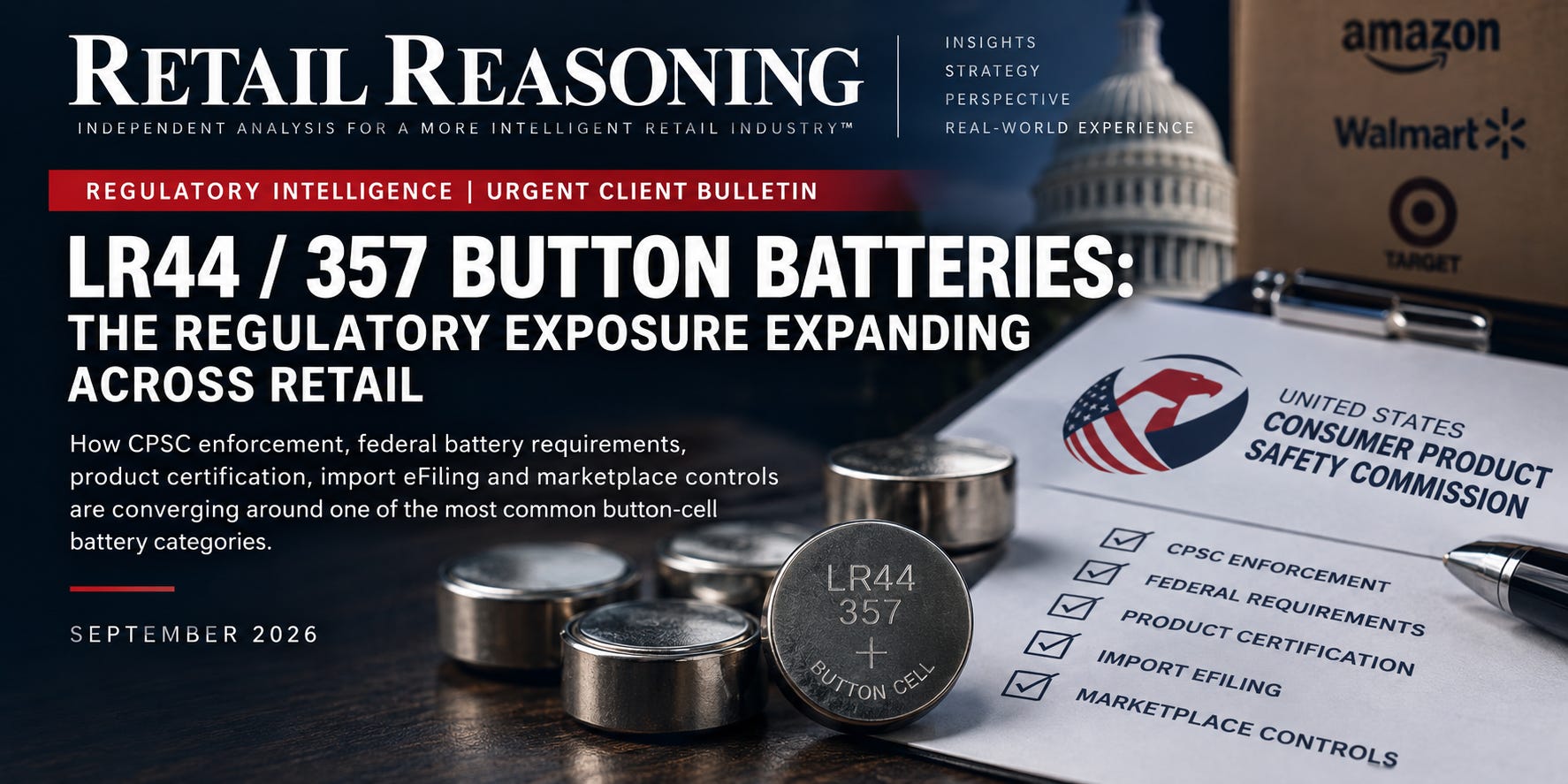
How CPSC enforcement, federal battery requirements, product certification, import eFiling and marketplace controls are converging around one of the most common button-cell battery categories
September 2026
Executive Summary
LR44 and 357 button batteries are inexpensive, widely available and embedded in thousands of consumer products. They are used in small electronics, lights, toys, calculators, novelty products, watches, medical and personal devices, decorative products and countless other low-cost consumer goods.
That ubiquity is precisely what makes the category important for retailers.
The federal regulatory framework governing button-cell and coin batteries has now been in place long enough that the issue has moved beyond a new-rule implementation question. The requirements are active. Products manufactured or imported under the applicable dates must comply, and the U.S. Consumer Product Safety Commission has demonstrated that it is willing to take action against products using LR44 batteries specifically.¹
At the same time, the compliance environment surrounding imported consumer products has changed materially. Beginning July 8, 2026, importers of regulated consumer products became subject to mandatory electronic filing of Certificate of Compliance information with U.S. Customs and Border Protection through the CPSC eFiling program.² That development matters because it gives CPSC substantially more structured information about regulated products entering the United States and connects product-level compliance documentation more directly to the import process. If you are a CEO and you haven’t heard your team implementing this months ago (and your products use the affected batteries) you’re about to run into a compliance wall.
Marketplace operators are responding as well. Walmart has told Marketplace sellers that they are responsible for complying with applicable CPSC requirements and for ensuring that an appropriate importer is responsible for electronically filing required certificates. Walmart has also stated that it will not serve as the importer for Marketplace sellers.³
The result is a more connected compliance chain.
A retailer can no longer look at a button-battery product solely as a merchandising decision. The battery itself, the finished product, the battery compartment, the product warnings, the packaging, the manufacturer’s testing, the certificate of conformity, the importer of record and the marketplace listing can all become parts of the same compliance question.
For retailers carrying products that contain or are designed to use LR44, 357 or similar button batteries, this creates a practical need for SKU-level review.
The most important point is simple:
LR44/357 should now be treated as a product-compliance trigger during sourcing and assortment review, rather than as an ordinary component specification.
This report explains why.
What This Report Covers
This report examines five issues that are converging around LR44/357-type products:
First, the federal requirements. What Reese’s Law and the implementing CPSC regulations actually require of batteries and products that contain or use them.
Second, the enforcement signal. Why recent CPSC actions involving products containing LR44 batteries provide a particularly useful indicator of where enforcement risk is developing.
Third, the marketplace environment. How marketplace operators are incorporating CPSC compliance into seller requirements and product controls.
Fourth, the import process. Why the July 2026 CPSC eFiling requirement changes the practical compliance burden for imported products.
Fifth, the retail response. What merchants, category managers, sourcing teams and marketplace sellers should be doing now to identify and address exposure at the SKU level.
The purpose is not simply to summarize the law. The more important question for a retail executive is what the law means for the product pipeline.
1. WHY LR44 / 357 IS NOW A RETAIL ISSUE
The LR44 is a small alkaline button battery commonly sold under several related designations. The 357 designation is commonly associated with a silver-oxide version of a similar physical size. Product specifications and chemistry can differ, so retailers should not assume that the terms are interchangeable for every purpose.
The important regulatory question, however, is not whether a supplier calls a battery an LR44, AG13, 357 or another commercial designation.
The federal framework focuses on the physical characteristics of the battery and whether it falls within the statutory and regulatory definition of a covered button cell or coin battery. CPSC defines a button cell or coin battery as a single-cell battery with a diameter greater than its height, along with any other battery the Commission determines poses an ingestion hazard.⁴
That distinction matters.
A retailer conducting a compliance review should therefore search supplier documentation, product specifications and listings for the battery’s actual model designation and physical characteristics rather than relying solely on a keyword such as “LR44.”
LR44 batteries are particularly relevant because they appear in a large number of inexpensive products. They are small enough to be incorporated into products that may have little apparent connection to the battery market.
That creates an unusual retail problem.
The product being sold may be a toy, light, ornament, electronic accessory or novelty item. The compliance issue may nevertheless originate with the battery compartment and the accessibility of the battery.
CPSC enforcement illustrates the point.
In 2025, CPSC warned consumers about children’s light-up ballet skirts sold online that contained three LR44 alkaline button batteries. The battery compartment allowed the batteries to be accessed by children, and the products lacked required warnings. CPSC stated that the products violated the mandatory federal requirements governing consumer products containing button-cell or coin batteries.⁵
This is important because the enforcement action was not directed at a battery manufacturer selling a package of LR44 batteries.
It involved a finished consumer product.
That distinction should change how retailers think about the category.
2. THE REGULATORY FRAMEWORK
The federal framework originated with Reese’s Law, enacted in 2022 following the death of Reese Hamsmith, an 18-month-old child who ingested a button battery.
The law directed CPSC to establish requirements for button-cell and coin batteries and consumer products containing or designed to use them.
CPSC subsequently incorporated ANSI/UL 4200A into its mandatory safety standard. The resulting requirements are codified in 16 CFR Part 1263.⁶
There are two related but distinct regulatory issues.
The first concerns consumer products that contain or are designed to use covered button-cell or coin batteries.
The second concerns the packaging and labeling of the batteries themselves when sold as standalone products.
Retailers need to keep these two obligations separate because they operate differently.
Consumer products containing button batteries
For covered consumer products, the federal standard addresses battery accessibility, product construction, testing and warnings.
Among other requirements, the battery compartment generally must be secured in a manner intended to prevent access by children. The standard also incorporates use-and-abuse testing designed to evaluate whether the battery can become accessible during foreseeable use or misuse.
Warnings are also required.
The requirements apply differently depending upon whether the finished product is a general-use product or a children’s product.
For general-use products subject to the rule, the manufacturer or importer must provide the required certification of conformity.
For children’s products, the compliance burden is higher because children’s products subject to federal safety requirements generally require third-party testing by a CPSC-accepted laboratory and a Children’s Product Certificate.⁷
That distinction can materially affect sourcing economics.
A product that appears to be a simple $5 or $10 consumer item may carry a substantially different compliance burden if it is marketed, designed or classified as a children’s product.
Retailers should therefore avoid assuming that the battery requirement can be evaluated independently of the product’s intended audience.
3. STANDALONE LR44 / 357 BATTERIES HAVE THEIR OWN REQUIREMENTS
A retailer selling packages of LR44 or 357 batteries is dealing with a different compliance question from a retailer selling a flashlight that happens to contain an LR44 battery.
Reese’s Law also established special packaging requirements for covered button-cell and coin batteries.
CPSC’s current guidance states that covered button-cell and coin batteries manufactured or imported after February 12, 2023 must be packaged in accordance with the applicable child-resistant packaging requirements. Additional battery-package labeling requirements apply to products manufactured or imported after September 21, 2024.⁸
The packaging requirement is significant because the battery itself can create an ingestion hazard even when it is not installed in a consumer product.
Retailers therefore need to distinguish among at least three situations:
A standalone package of LR44/357 batteries.
A consumer product containing an LR44/357 battery.
A consumer product designed to use an LR44/357 battery, even when the battery is not supplied with the product.
The compliance analysis can differ among those scenarios.
This is one reason a simple product search for “contains battery” is inadequate for a retail compliance program.
The question should be whether the product contains or is designed to use a covered battery.
4. THE LR44 / 357 ENFORCEMENT SIGNAL
The clearest reason for retailers to pay attention to LR44/357 specifically is that CPSC enforcement has already reached the category.
In November 2025, CPSC announced the recall of Great Lakes Select battery packs that included a 24-pack of LR44/357 Super Alkaline batteries. The affected item was sold nationally from September 2024 through August 2025. CPSC stated that the battery packaging did not meet the required child-resistant packaging and warning requirements.⁹
The recall is notable for several reasons.
First, the product was inexpensive. The LR44/357 package sold for approximately $1.10 to $1.50.
Second, the product was a conventional standalone battery package rather than an unusual electronic device.
Third, the product had been sold through multiple retail outlets.
Fourth, the enforcement action demonstrates that CPSC’s attention is not limited to the most recognizable lithium coin batteries such as CR2032.
The LR44/357 category is clearly within the enforcement landscape.
The broader enforcement picture reinforces that conclusion.
CPSC has also taken action involving other button-cell products, including products where batteries were accessible to children or where required warnings were absent.
The regulatory risk therefore extends beyond the battery aisle.
A product can create exposure because of the battery it contains, the way that battery is installed, the way the battery compartment is constructed or the way the product is labeled and marketed.
5. THE MARKETPLACE HAS BECOME PART OF THE COMPLIANCE SYSTEM
For traditional brick-and-mortar retail, a product compliance issue historically moved through a relatively familiar chain:
manufacturer, importer, distributor, retailer and consumer.
Marketplace commerce adds another layer.
The marketplace may control the product listing, seller account, fulfillment process, documentation requirements and enforcement mechanism.
CPSC has already warned about button-cell products sold through online marketplaces. In one 2025 enforcement action involving children’s light-up products containing LR44 batteries, the products were sold online and CPSC issued a Notice of Violation to the seller.¹⁰
This creates a practical problem for marketplace sellers.
The marketplace does not necessarily need to wait for a federal recall before acting against a product.
A marketplace can impose its own documentation requirements, request testing records, restrict a listing, suspend a seller or require corrective action based on its interpretation of the applicable product-safety requirements.
That means regulatory compliance and marketplace compliance are increasingly intertwined.
6. WALMART’S NEW CPSC eFILING REQUIREMENT IS A SIGNIFICANT DEVELOPMENT
Walmart has now explicitly incorporated the new CPSC eFiling environment into its Marketplace requirements.
Walmart announced in August 2026 that importers of products subject to mandatory CPSC safety rules must electronically submit Certificates of Compliance through the CPSC eFiling process. Walmart stated that the requirement became effective July 8, 2026, with Foreign Trade Zone requirements beginning January 8, 2027.¹¹
Walmart also places responsibility on the Marketplace seller to ensure that the appropriate importer is responsible for the filing.
For a seller using imported inventory, this creates an important operational question:
Who is actually responsible for the compliance certificate associated with the product entering the United States?
That question should be answered before the product is sourced, not after a shipment is held or a listing is suspended.
For sellers using overseas suppliers, the importer relationship needs to be understood at the SKU level.
The retailer should know:
Who manufactured the product.
Who manufactured the battery, where relevant.
Who imported the finished product.
Who issued or maintains the applicable certificate.
What testing supports the certification.
Which SKU, model number or product identifier the certificate covers.
And whether the product sold online is actually the same configuration represented by the compliance documentation.
That last point is particularly important.
A certificate is only useful if it actually describes the product being sold.
7. CPSC eFILING CHANGES THE IMPORT COMPLIANCE ENVIRONMENT
The July 8, 2026 implementation of mandatory CPSC eFiling is one of the most consequential changes in the practical compliance environment.
CPSC now requires importers of regulated consumer products subject to certification requirements to electronically file certificate information as part of the import process.¹²
The program is designed to give CPSC certificate information before regulated products enter U.S. commerce.
This changes the role of compliance documentation.
Historically, a retailer could think of a certificate as something that needed to exist in a file somewhere in case an agency, retailer or marketplace requested it.
That remains important, but the import environment now makes the information more operational.
The certificate becomes part of the data associated with the import transaction.
CPSC’s eFiling guidance states that a certificate must affirm that the product was tested to all applicable CPSC requirements and complies with the listed regulations. Certificates must identify applicable rules, standards and regulations, the most recent testing date and the testing laboratories used. Beginning July 8, 2026, applicable testing exclusions must also be identified.¹³
That creates a new level of discipline around product records.
A supplier saying that a product is “CPSC compliant” is not enough.
The retailer needs to know what regulation the supplier is relying upon, what testing supports the claim and which finished product the documentation actually covers.
8. eFILING IS NOT SIMPLY A NEW FORM
There is an important distinction between CPSC eFiling and what many people might casually describe as “product registration.”
The new system does create a structured electronic record of certificate information, and CPSC operates a Product Registry as part of the eFiling program.
But eFiling does not create a universal government registration requirement for every consumer product.
The underlying compliance obligation already exists.
The new requirement changes how certificate information is transmitted for regulated imported products.
That distinction matters because a retailer could otherwise misunderstand the requirement as a one-time registration process.
It is better understood as part of the import compliance workflow.
The certificate still needs to be accurate.
The testing still needs to support the certification.
The product still needs to comply.
The importer still has responsibility.
The eFiling system simply gives CPSC a more direct and structured way to receive and use the compliance information.
9. THE SKU-LEVEL COMPLIANCE PROBLEM
This is where the issue becomes particularly important for retail executives.
A company may have thousands of active SKUs and no obvious indication in its merchandising system that a particular product contains a button battery.
The battery may be buried in the bill of materials.
The supplier may describe it only as “AG13,” “LR44,” “A76,” “357,” or another designation.
The product title may never mention a battery.
The packaging may show a generic battery icon.
The product may be classified internally as a toy, novelty, personal accessory, lighting product or electronic device.
The result is a visibility problem.
A retailer cannot effectively manage a regulatory requirement if it does not know which SKUs trigger the requirement.
For this reason, the first step in a serious review should be creating a battery-product inventory.
At minimum, the inventory should identify:
SKU or item number
Product name
Supplier
Country of manufacture
Importer of record
Battery type
Battery model or designation
Number of batteries
Whether batteries are included
Whether the product is designed to use batteries
Battery compartment design
Target consumer or age grading
Applicable certification
Testing documentation
Packaging documentation
Warning documentation
Marketplace status
Current certificate holder
This is a relatively simple exercise compared with the disruption that can occur after a product has been listed, imported and distributed.
10. WHAT RETAILERS SHOULD LOOK FOR
A practical review should begin with products most likely to create exposure.
The first group is products that contain LR44, 357, AG13, A76 or physically similar button batteries.
The second group is children’s products.
The third group is products sold with loose batteries in the package.
The fourth group is products where the battery compartment can be opened without a tool or without the required level of protection.
The fifth group is imported products for which the supplier cannot quickly produce credible testing and certification documentation.
The sixth group is marketplace products sourced from multiple suppliers under the same or similar listing.
That last category deserves particular attention.
A retailer can have a compliant product configuration and then unintentionally introduce a different supplier’s version under the same listing.
The product may look identical in a photograph while using a different battery compartment, different battery supplier, different packaging or different warning language.
From a retail systems perspective, this creates a traceability problem.
Compliance should follow the actual product configuration, not simply the marketing image.
11. WHAT GOOD SUPPLIER DOCUMENTATION SHOULD LOOK LIKE
Retailers should be skeptical of vague compliance statements.
A supplier statement saying “FDA approved,” “CE certified,” “CPSC approved” or “meets U.S. standards” does not, by itself, establish compliance with the specific requirements applicable to a button-battery product. Compatible is no longer the standard, as import requirements and marketplace compliance require specific, certified laboratory test results at the per product level.
The documentation package should be specific.
For a general-use finished product, the retailer should be able to identify the applicable CPSC requirement and the corresponding General Certificate of Conformity.
Where testing is required, the retailer should be able to identify the testing laboratory and the test report supporting the certification.
For children’s products, the retailer should expect the applicable Children’s Product Certificate and supporting third-party testing.
For standalone button-cell batteries, the retailer should separately evaluate the packaging and labeling requirements.
The retailer should also retain the version of the product and packaging that was actually tested.
That last point is frequently overlooked.
A laboratory report for one packaging configuration does not automatically establish compliance for a different configuration.
A supplier changing the battery compartment, packaging, warning panel or battery supplier can create a new compliance question even when the product’s marketing description has not changed.
12. THE IMPORTER OF RECORD DESERVES SPECIAL ATTENTION
The eFiling environment makes the importer relationship more important.
Retail organizations should be able to answer a straightforward question for every imported regulated product:
Who is responsible for the CPSC certificate associated with this import?
If the answer is unclear, the compliance process is incomplete.
This is particularly important for marketplace sellers that source products from overseas suppliers.
A supplier may manufacture the product.
A freight forwarder may move the shipment.
A customs broker may facilitate entry.
A marketplace may fulfill the order.
But those parties do not automatically assume the same legal responsibilities.
Walmart’s current Marketplace guidance makes the point directly by requiring sellers to identify an appropriate importer responsible for eFiling and stating that Walmart will not serve as the importer for Marketplace sellers.¹⁴
That means the seller needs to understand its own supply chain rather than assuming that the marketplace is absorbing the regulatory obligation.
13. THE TIMELINE MATTERS
The federal requirements have been phased in over several years.
The following dates provide the practical compliance timeline.
February 12, 2023
Child-resistant packaging requirements began applying to covered button-cell and coin batteries manufactured or imported after this date.¹⁵
October 23, 2023
Federal performance and labeling requirements under 16 CFR Part 1263 began applying to covered general-use consumer products containing or designed to use button-cell or coin batteries manufactured or imported on or after this date.¹⁶
December 20, 2023
The corresponding requirements began applying to covered children’s products.¹⁷
September 21, 2024
Additional labeling requirements for standalone button-cell and coin-battery packaging became applicable.¹⁸
July 8, 2026
Mandatory CPSC eFiling became effective for most regulated imported consumer products subject to certification requirements.¹⁹
January 8, 2027
The eFiling requirements will extend to applicable products entering from Foreign Trade Zones.²⁰
The significance of this timeline is that the regulatory environment is now mature.
Retailers should not treat button-cell compliance as an upcoming requirement.
For the products already covered by the applicable effective dates, it is an existing requirement.
14. A NEW DEVELOPMENT: UL 4200A-2026
There is another development worth watching.
CPSC announced in September 2026 that UL had revised the voluntary standard incorporated into the federal button-cell rule from UL 4200A-2023 to UL 4200A-2026. CPSC is currently seeking comment on whether the revised standard improves safety.²¹
The comment deadline is September 17, 2026 (next week, as of our date of publication.)
This does not mean that every retailer suddenly has a new testing requirement today.
The regulatory process still has to run its course.
However, retailers with significant exposure to button-cell products should watch the development because the federal rule incorporates the UL standard by reference.
A change in the incorporated standard can eventually affect the testing and design expectations applied to covered products.
For sourcing teams, this is another reason to avoid treating compliance as a static document that can be filed away indefinitely.
Product safety standards can evolve.
15. WHAT THIS MEANS FOR MARKETPLACES
The practical implication for marketplace sellers is straightforward.
The combination of federal regulation, CPSC eFiling and marketplace enforcement creates several independent points at which a product can encounter friction.
A product can be questioned by CPSC.
It can encounter an import problem.
It can be subject to a documentation request.
It can be removed by a marketplace.
It can be placed on hold while compliance information is reviewed.
Or it can remain listed until an incident, complaint or regulatory action brings the product to attention.
The fact that a product has been selling successfully does not establish that it is compliant.
That may be the most important operational lesson in this entire category.
Historical sales are not a compliance certificate.
A product can sell thousands of units before anyone examines its battery compartment or asks for its supporting documentation.
Retailers should therefore resist using sales history as a proxy for regulatory acceptance.
16. THE RETAILER’S PRACTICAL RESPONSE
The appropriate response does not require pulling every product containing an LR44 battery from the market.
It requires creating visibility.
A practical program can begin with a targeted SKU audit.
Step One: Identify the products
Search product databases, supplier catalogs, bills of materials, packaging files and marketplace listings for:
LR44
357
AG13
A76
button battery
coin battery
button cell
coin cell
and related battery specifications.
Do not rely on one terminology.
Step Two: Determine whether the product is covered
Confirm whether the product contains or is designed to use a covered button-cell or coin battery.
Determine whether it is a general-use product or a children’s product.
Step Three: Review the physical design
Examine the battery compartment.
Determine how the battery is retained.
Determine how the compartment is opened.
Confirm that the configuration matches the tested product.
Step Four: Review warnings
Confirm that required warnings appear where applicable on the product, packaging and instructions.
Step Five: Review certification
Obtain the applicable GCC or CPC and supporting test documentation.
Make sure the documents correspond to the exact product configuration.
Step Six: Review the battery itself
If the battery is supplied separately, review the battery packaging and labeling requirements independently.
Step Seven: Review the importer
Identify the importer responsible for the applicable CPSC certification and eFiling obligation.
Step Eight: Review marketplace requirements
Confirm that the marketplace’s product-safety requirements have also been satisfied.
Step Nine: Preserve the evidence
Keep the testing, certification, packaging artwork, photographs, supplier records and product specifications together.
The objective should be a defensible SKU file.
17. WHAT A DEFENSIBLE SKU FILE LOOKS LIKE
For higher-risk products, the ideal file should allow a compliance manager to answer the following question quickly:
“Show me why this exact product is legal to sell in the United States.”
The answer should not require an email chain with an overseas supplier.
It should not depend upon a generic PDF downloaded from a manufacturer’s website.
It should not depend upon a supplier saying that another retailer sells the same item.
The file should contain the actual evidence.
That includes the product identification, supplier information, battery specification, product photographs, packaging photographs, applicable certificate, supporting test reports, applicable warnings and the identity of the responsible importer.
For marketplace products, the file should also connect the compliance documentation to the listing or SKU being sold.
This is increasingly important because retail organizations are becoming more dependent upon data-driven compliance systems.
The future of product compliance is likely to be increasingly SKU-specific and increasingly digital.
18. THE BROADER RETAIL IMPLICATION
LR44/357 is useful as a case study because the battery itself is inexpensive and familiar.
The larger issue is the compliance infrastructure developing around products that enter the United States through global supply chains.
CPSC eFiling creates a more structured connection between the product, its certificate and its import transaction.
Marketplaces increasingly demand documentation before allowing products to remain active.
Retailers are becoming more responsible for understanding what their suppliers are actually selling.
And regulators have demonstrated that enforcement can reach products that appear commercially insignificant.
That combination changes the economics of compliance.
For a high-volume retailer, a $1 product can generate a disproportionately large compliance problem if it creates a listing suspension, import hold, recall, customer-safety issue or marketplace account restriction.
The cost of the product is therefore a poor measure of the cost of noncompliance.
This is particularly relevant to private-label and marketplace businesses, where hundreds or thousands of inexpensive products may be sourced from different manufacturers.
The lower the product’s price and the greater the SKU count, the easier it becomes for compliance gaps to hide inside the assortment.
19. RETAIL REASONING ASSESSMENT
Retail Reasoning believes the most important development in the LR44/357 category is not a single new rule.
It is the convergence of several existing requirements into a much more visible compliance system.
Reese’s Law established the underlying safety requirements.
CPSC created the implementing regulations.
Enforcement has demonstrated that the rules apply to ordinary consumer products and specifically to products containing LR44 batteries.
Mandatory eFiling has now connected regulated product certification more directly to the import process.
Marketplaces are incorporating those requirements into seller compliance.
And CPSC is evaluating a revised version of the technical standard incorporated into the federal rule.
Taken together, these developments point toward a retail environment in which product compliance will increasingly be evaluated at the individual SKU level.
The companies best positioned to operate in that environment will be those that can answer three questions quickly:
What exactly are we selling?
What regulation applies to it?
Where is the evidence that it complies?
That sounds simple.
In a large retail organization, it is not.
The underlying challenge is data integrity.
A retailer can have a certificate and still have the wrong product.
It can have a compliant product and still have the wrong packaging.
It can have compliant packaging and still have an outdated certificate.
It can have all of those things and still have uncertainty about who is responsible for the import filing.
The compliance system therefore has to connect the product, the documentation and the supply chain.
That is the real lesson from the LR44/357 category.
20. WHAT RETAIL EXECUTIVES SHOULD DO NOW
For retailers and marketplace operators with meaningful exposure to button-cell products, Retail Reasoning recommends five immediate actions.
1. Build a button-cell SKU list.
Identify every product that contains or is designed to use LR44, 357, AG13, A76 or another covered button-cell or coin battery.
2. Prioritize children’s products.
Children’s products generally carry a more demanding testing and certification regime and should receive immediate attention.
3. Verify documentation against the actual product.
Do not accept generic supplier statements. Match the certificate and test documentation to the product configuration being sold.
4. Establish importer accountability.
Know which entity is responsible for the applicable CPSC certification and eFiling obligations for imported products.
5. Create a recurring compliance review.
A product should be re-evaluated when its battery, battery compartment, packaging, supplier, manufacturer, importer or intended use changes.
These five actions will identify the majority of the practical exposure without requiring a retailer to launch a full enterprise-wide product compliance overhaul on day one.
David Happe from Retail Reasining is available on a fractional basis for compliance evaluation, process documentation, and crisis troubleshooting. For a free initial consultation, email help@retailreasoning.com and Dave will respond personally to set up a time for a quick free consultation and needs analysis.
21. THE BOTTOM LINE
LR44 and 357 batteries are small products with a surprisingly large compliance footprint.
The federal rules governing button-cell and coin batteries are already in effect.
CPSC has already taken enforcement action involving products containing LR44 batteries.
Standalone battery packaging is subject to its own requirements.
General-use and children’s products can carry different certification and testing obligations.
Mandatory CPSC eFiling has now added an import-level compliance requirement.
Marketplace operators are increasingly incorporating those requirements into their own seller controls.
And the technical standard underlying the federal rule is currently being reviewed for a 2026 revision.
For retailers, the appropriate response is not to treat every LR44/357 product as a regulatory emergency.
The appropriate response is to know where those products exist in the assortment, understand which requirements apply, verify the documentation and establish who owns the compliance responsibility.
The cost of doing that review is modest.
The cost of discovering the problem after an import, marketplace suspension, regulatory action or recall can be considerably higher.
For that reason, Retail Reasoning considers LR44/357-type products a useful early-warning category for a much broader change taking place across retail:
Product compliance is becoming a data problem as much as a legal or product-safety problem.
The retailers that understand that shift early will have an advantage over those that continue to treat compliance documentation as paperwork kept somewhere in a supplier’s inbox.
RESEARCH NOTES AND SOURCES
1. U.S. Consumer Product Safety Commission, “Great Lakes Wholesale International Recalls Select Battery Packs Due to Battery Ingestion; Violates Federal Statute for Child-Resistant Packaging of Button Cell and Coin Batteries.” The recall included a 24-pack of LR44/357 Super Alkaline batteries and stated that the packaging violated applicable child-resistant packaging and warning requirements.
2. U.S. Consumer Product Safety Commission, “CPSC Implements Mandatory eFiling for Certificates of Compliance.” CPSC announced that mandatory eFiling became effective July 8, 2026 for regulated imported consumer products requiring certification.
3. Walmart Marketplace, “New CPSC e-Filing Requirement for Imported Products.” Walmart’s August 2026 Marketplace notice explains the eFiling requirement and states that Marketplace sellers must serve as the importer or designate an appropriate importer; Walmart will not serve as importer for Marketplace sellers.
4. U.S. Consumer Product Safety Commission, Button Cell and Coin Battery Business Guidance and FAQs. CPSC defines a covered button-cell or coin battery based principally on the battery’s physical dimensions and addresses additional batteries determined to present an ingestion hazard.
5. U.S. Consumer Product Safety Commission, “CPSC Warns Consumers to Immediately Stop Using Kids Light Up Ballet Skirts.” CPSC reported that the products contained three LR44 alkaline button batteries, that the batteries could be accessed by children and that required warnings were absent.
6. U.S. Consumer Product Safety Commission, Button Cell and Coin Battery Business Guidance. CPSC states that Reese’s Law requires federal safety requirements for button-cell and coin batteries and that the mandatory rule is codified at 16 CFR Part 1263 and incorporates ANSI/UL 4200A-2023.
7. U.S. Consumer Product Safety Commission, General Use Products: Certification and Testing. CPSC explains certification requirements for general-use products and the applicable General Certificate of Conformity framework.
8. U.S. Consumer Product Safety Commission, Button Cell and Coin Battery FAQs. CPSC identifies the February 12, 2023 and September 21, 2024 effective dates for standalone button-cell and coin-battery packaging requirements.
9. U.S. Consumer Product Safety Commission, Great Lakes Wholesale International recall. The recalled LR44/357 product was sold nationally from September 2024 through August 2025.
10. U.S. Consumer Product Safety Commission, Kids Light Up Ballet Skirts warning. The CPSC action provides an example of enforcement involving an ordinary finished consumer product containing LR44 batteries rather than a standalone battery package.
11. Walmart Marketplace, CPSC eFiling requirements. Walmart states that the eFiling requirement became effective July 8, 2026 and that applicable Foreign Trade Zone products become subject to the requirement January 8, 2027.
12. U.S. Consumer Product Safety Commission, Update: Certificates of Compliance and eFiling. CPSC states that all importers of consumer products subject to CPSC certification must electronically file certificate data as of the applicable effective dates.
13. U.S. Consumer Product Safety Commission, eFiling Frequently Asked Questions. CPSC describes the information required in certificates, including applicable rules, standards, testing dates, testing laboratories and, beginning July 8, 2026, applicable testing exclusions.
14. Walmart Marketplace, CPSC eFiling requirements. Walmart expressly places responsibility on Marketplace sellers to serve as importer or designate an appropriate importer for eFiling purposes.
15. U.S. Consumer Product Safety Commission, Button Cell and Coin Battery FAQs. Covered battery packaging requirements began applying to products manufactured or imported after February 12, 2023.
16. U.S. Consumer Product Safety Commission, Button Cell and Coin Battery Business Guidance. The Part 1263 requirements for covered general-use consumer products became applicable to products manufactured or imported on or after October 23, 2023.
17. U.S. Consumer Product Safety Commission, Button Cell and Coin Battery FAQs. The requirements for covered children’s products became applicable to products manufactured or imported on or after December 20, 2023.
18. U.S. Consumer Product Safety Commission, Button Cell and Coin Battery FAQs. Battery-package labeling requirements under 16 CFR §1263.4 apply to products manufactured or imported after September 21, 2024.
19. U.S. Consumer Product Safety Commission, CPSC eFiling announcement. Mandatory eFiling for most regulated imported consumer products became effective July 8, 2026.
20. U.S. Consumer Product Safety Commission, Update: Certificates of Compliance and eFiling. CPSC identifies January 8, 2027 as the effective date for applicable Foreign Trade Zone entries.
21. Federal Register, 91 FR 56604, “Notice of Availability and Request for Comment: Revision to the Voluntary Standard for Products Containing Button Cell or Coin Batteries.” Published September 3, 2026, the notice concerns UL 4200A-2026 and requests comments by September 17, 2026.
Methodology
This report was prepared as regulatory intelligence for retail executives and marketplace operators. The analysis focuses on primary regulatory sources, CPSC enforcement materials and marketplace compliance requirements available as of September 2026.
The report distinguishes between federal legal requirements, CPSC guidance, enforcement activity and marketplace policies. Where a development remains under regulatory consideration, such as the UL 4200A-2026 revision, it is identified as such rather than treated as an effective new requirement.
Retail Reasoning recommends that companies consult qualified legal and product-safety professionals when making product-specific compliance determinations.
About Retail Reasoning
Retail Reasoning™ provides independent retail analysis for executives responsible for merchandising, sourcing, operations, strategy and growth.
The service is built around a simple premise:
Executives do not need more information. They need better judgment about what the information means.
Retail Reasoning combines retail experience, evidence-based research and structured analysis to identify the developments that matter, explain their commercial implications and help decision-makers determine what to do next.
Research is independent and designed for executives operating in a rapidly changing retail environment.